
Beyond borders: Why Cultural Intelligence matters more than where you are from
Every now and then, someone expresses surprise that I can facilitate an intercultural program about any culture, not just the one I was born into.
It is a reaction I have grown used to, yet it always sparks an interesting conversation. Many people still assume that to understand or teach a culture, you must be from that culture, that true insight only comes from lived, local experience.
While lived experience certainly helps, intercultural competence is not about origin, it is about observation.
It is how you think, how you observe, and how you adapt.
From anthropology to intercultural mastery
This idea is not new. Since the early days of anthropology, the pioneers of cross-cultural research did not specialise in one country or people. They immersed themselves in understanding how humans make meaning, how we interpret politeness, time, hierarchy, and relationships differently.
Through their work, they revealed something profound: culture is not fixed or local, it is patterned, learnable, and transferable.
Those early frameworks have evolved into what we now use in intercultural consulting and global leadership development, structured ways of understanding and navigating cultural differences. And at the heart of these frameworks lies one key capability: Cultural Intelligence, or CQ®.
What is Cultural Intelligence (CQ)?
Cultural Intelligence (CQ) is the ability to work and relate effectively across cultures, not just national ones, but also organisational, generational, and functional cultures.
It is what allows a leader in Melbourne to collaborate with a team in Mumbai, a client in Paris, or a partner in São Paulo, and achieve meaningful outcomes despite vastly different expectations and norms.
CQ goes beyond surface-level knowledge of etiquette or customs. It is about developing the mindset and skills to adapt to new contexts, interpret behaviours accurately, and build trust across differences.
And the good news? CQ is not an innate talent or something you are born with; it is a learnable capability. Anyone can build it with curiosity, awareness, and practice.
The power of being an outsider
Being an “outsider” is often seen as a disadvantage, yet in intercultural work, it can be an incredible strength.
When you operate outside your familiar environment, you notice the small details others might overlook: the tone of voice, the pauses in conversation, the hierarchy implied by who speaks first. These subtle cues become data points for understanding how people see the world.
As outsiders, we develop empathy through observation. We become less certain about being “right” and more interested in understanding why others do what they do.
That humility and curiosity are the foundation of Cultural Intelligence.
Ultimately, the goal is not to belong to every cultures, it is to build the capacity to bridge between them.
CQ in practice: the four core capabilities
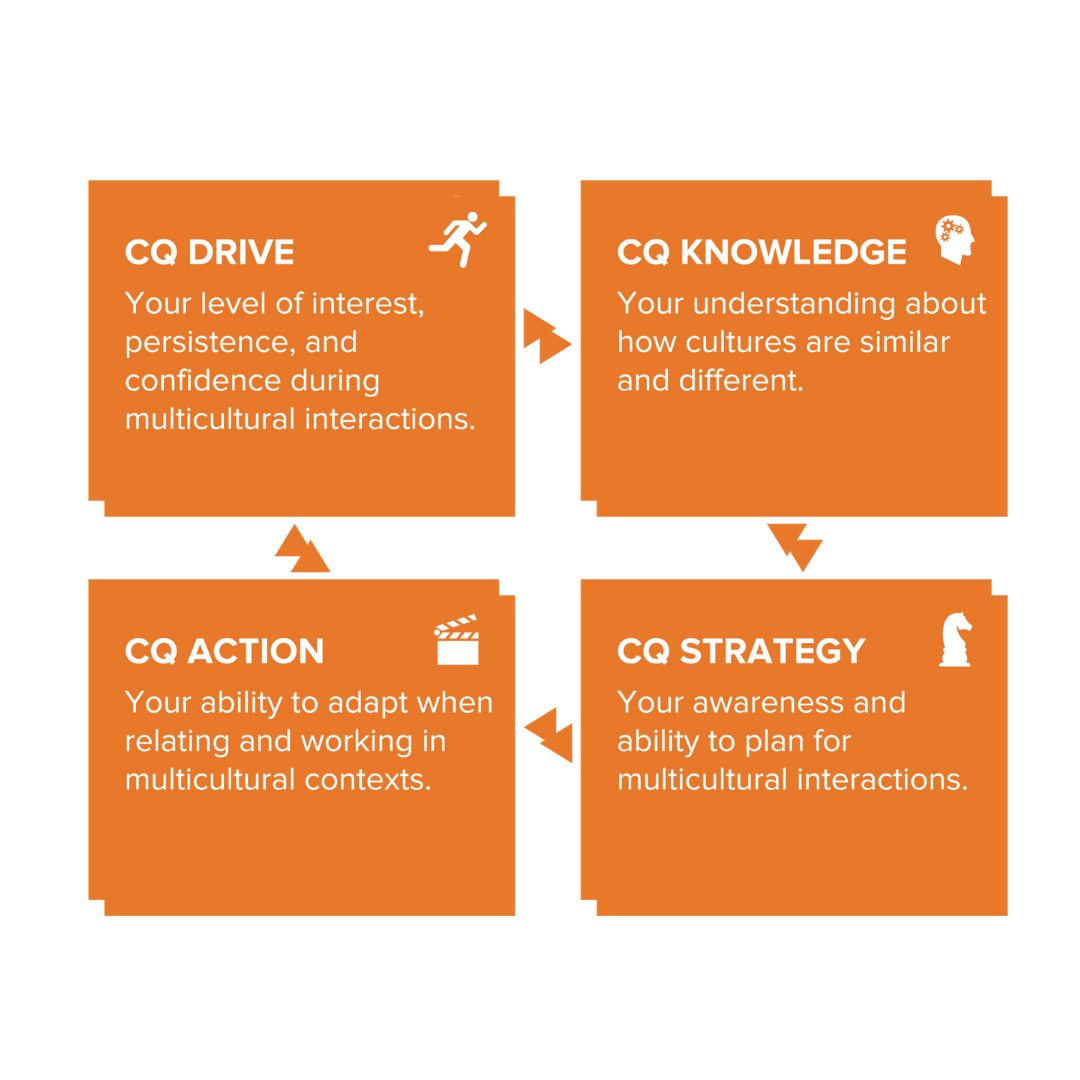
Building CQ involves cultivating four interrelated capabilities. Together, they form a roadmap for leading and collaborating effectively in a global environment.
💠 Drive — The Motivation to Engage Across Cultures
This is your curiosity and openness. It is the inner motivation that pushes you to engage, even when the context feels unfamiliar or uncomfortable. Leaders with strong CQ Drive see difference not as a threat, but as an opportunity to learn.
💠 Knowledge — Understanding How Cultures Differ and Why
This goes beyond knowing a few facts about a country. It is about understanding how values and systems, such as hierarchy, communication, and time orientation, influence people’s behaviour at work.
💠 Strategy — Making Sense of Cultural Situations
CQ Strategy is about reflection and awareness. It helps leaders plan interactions thoughtfully, pause before reacting, and interpret cultural cues accurately rather than relying on assumptions.
💠 Action — Adapting Behaviour Effectively
The final capability brings it all together. It’s the ability to adjust your communication, decision-making, and leadership style to fit the context, without losing authenticity or integrity.
These four capabilities are what allow leaders to shift from frustration to flexibility, from confusion to connection.
Why CQ is essential for global leaders
Today’s leaders operate in a world that is more interconnected and more complex than ever before.
Multicultural teams are now the norm, not the exception. Yet many leaders still struggle with misunderstandings, misaligned expectations, and silent friction that undermines collaboration.
High Cultural Intelligence changes that.
Leaders with CQ create environments where people feel seen, heard, and understood, where diverse perspectives are not just tolerated but leveraged for innovation and performance.
Studies consistently show that teams with high CQ demonstrate:
Stronger trust and psychological safety,
Greater idea sharing and innovation, and
Higher overall performance in multicultural settings.
In other words, CQ is about performing better across cultures.
Moving beyond borders
In global roles, success is determined by your ability to notice, question, and adapt.
The leaders who thrive today are not necessarily those with the most international experience, but those who have learned to think beyond borders, lead with empathy, and translate difference into connection.
Cultural Intelligence gives us the tools to do exactly that.
And as the world continues to evolve, the leaders who invest in developing their CQ will be the ones best equipped to unite people, ideas, and perspectives, wherever in the world they are.

How the CQ capabilities enhance your holiday planning
It all begins with an idea.
How the Four CQ Capabilities enhance your holiday planning
As the holiday season approaches, many of us start dreaming of destinations, exploring traditions, and preparing for memorable experiences. But have you ever considered how Cultural Intelligence (CQ) can elevate your holiday planning? Cultural Intelligence is the capability to function effectively across diverse cultural contexts, and its four key capabilities—CQ Drive, CQ Knowledge, CQ Strategy, and CQ Action—can make your holiday season richer, smoother, and more enjoyable.
1. CQ Drive: Cultivating Motivation and Curiosity
CQ Drive refers to your interest and confidence in engaging with different cultures. When planning a holiday, this capability fuels your excitement to explore unfamiliar traditions, cuisines, and customs.
For example, instead of choosing a familiar destination, CQ Drive might inspire you to visit a place that offers a new cultural experience, like enjoying Christmas markets in Europe or celebrating Chinese New Year in China. This intrinsic motivation makes the preparation process more enjoyable and ensures you’re open to fully immersing yourself in the experience.
2. CQ Knowledge: Building cultural awareness
CQ Knowledge is your understanding of how cultures differ, including values, norms, and practices. This awareness is crucial for respectful and meaningful holiday experiences.
For example, researching the etiquette of gift-giving in Japan or understanding the significance of Ramadan in a predominantly Muslim country can help you navigate interactions thoughtfully. Your holiday plans will reflect cultural respect, fostering deeper connections and avoiding unintentional faux pas.
3. CQ Strategy: Planning and adapting thoughtfully
CQ Strategy involves your ability to plan and monitor your interactions in culturally diverse situations. During holiday preparation, this capability ensures you’re intentional and flexible.
For example, if you’re visiting a country with unique public transportation norms, CQ Strategy helps you anticipate potential challenges and develop alternative plans.
With thoughtful planning, you’re better equipped to handle unexpected situations, like adapting to a sudden change in a festival schedule or local transportation strike. Like what might happen if you go to France :)
4. CQ Action: Bridging the gap with practical behaviour
CQ Action is your ability to adjust verbal and nonverbal behaviour to fit different cultural contexts. This is essential for creating positive experiences during your holiday.
For example, learning a few key phrases in the local language or adopting culturally appropriate gestures, such as bowing in Japan or giving a thumbs-up in Brazil, can enhance interactions.
These small but meaningful actions show respect and help you build rapport with locals, enriching your overall experience.
By integrating these four CQ capabilities into your holiday preparation, you create opportunities for deeper cultural appreciation, smoother interactions, and unforgettable memories. Whether you’re traveling abroad or exploring diverse traditions closer to home, CQ equips you to approach the holiday season with openness, adaptability, and respect.
This year, let Cultural Intelligence guide your holiday planning, and watch how it transforms your season of celebration into a journey of cultural connection.